









Google is where almost every patient journey starts. Someone notices a symptom, a niggle, a flare-up, or they get told by their GP they need to see a specialist, and within minutes they are on Google typing in a search. Our job is to make sure your practice is the one they find, book, and come back to. Our team has been running healthcare Google Ads for over a decade and we do nothing else.
What Healthcare Google Ads Actually Involves
We start with search campaigns matched to the services and locations your practice offers. Any additional channel needs a clear role, suitable creative and permitted measurement. We keep diagnoses, patient records, health interests and health-related website activity out of advertising audiences.
Then there is the compliance layer sitting on top of all of it. Google runs healthcare advertisers through a verification process. Ahpra has a separate set of rules that apply to any registered practitioner regardless of what Google allows. And the TGA has its own requirements for anyone advertising therapeutic goods or restricted representations. Many generalist agencies do not know these rules exist. We build every campaign with all three in mind from day one.
Planning Healthcare Google Ads Campaign Structures
The difference between a healthcare Google Ads account that generates enquiries and one that bleeds money usually comes down to campaign structure. We have refined our approach over a decade of healthcare campaigns. The structure follows a pattern: single-theme ad groups, tightly controlled keyword match types, dedicated landing pages per service, and a layered bidding strategy that starts with manual CPC or maximise clicks during the learning phase and graduates to target CPA or maximise conversions once we have enough conversion data to let the algorithm work properly.
For a typical medical practice, we build separate campaigns by service line. A physiotherapy clinic gets individual campaigns for back pain, sports injuries, post-surgical rehab, and workplace injuries. A dental practice gets implants, emergency, general, cosmetic, and orthodontics broken out separately. This matters because each service line has a different patient value, a different keyword cost, and a different conversion behaviour. Lumping them together means your implant budget subsidises general dentistry clicks and your Smart Bidding has no idea which conversions are worth chasing.
Ahpra-Compliant Ad Copy for Healthcare PPC
Writing ad copy for healthcare PPC that complies with Ahpra, satisfies Google's healthcare advertising policy, and still compels a patient to click is a skill most generalist agencies have never developed. Ahpra's advertising guidelines prohibit testimonials about clinical care, comparative superiority claims, language that creates unreasonable expectations, pressure tactics, and gifts or discounts without clear terms. Google's healthcare and medicines policy adds its own restrictions on what can be said in ad text, particularly around prescription medicines, cosmetic injectables, and mental health services.
We have built internal review checklists and ad copy frameworks specifically for Ahpra-compliant Google Ads. Every headline, description, sitelink, and callout goes through compliance review before it goes live. The result is ad copy that differentiates your practice, communicates your clinical strengths, and drives clicks without exposing you to regulatory risk. It takes longer than a generalist agency's approach, and that is deliberate.
Healthcare Landing Pages That Convert Clicks Into Patients
The landing page is where most healthcare Google Ads accounts leak money. A practice spends on high-intent clicks, and the patient lands on a generic homepage or a service page that reads like an information brochure. No clear call to action, no phone number above the fold, no trust signals, no reason to book now rather than later. The click cost is gone and the patient is back on Google clicking a competitor.
Our healthcare landing pages are purpose-built for each campaign and each service. They lead with the patient's intent: if someone searched for emergency dentist, the page opens with availability and a click-to-call button, not a history of the practice. If someone searched for psychologist bulk billing, the page confirms Medicare eligibility and explains the referral process before asking for a booking. Every landing page includes practitioner credentials, location details, and multiple conversion paths because some patients call, some submit forms, and some want to book online directly through your practice management system.
Landing page relevance also feeds directly into Quality Score, which determines your cost per click and ad position. Pages that closely match the ad copy and the searcher's intent earn higher Quality Scores, which means you pay less per click and appear higher on the page. We have seen healthcare practices reduce their CPC by 15 to 30 percent simply by replacing generic service pages with purpose-built landing pages that match the campaign structure.
Quality Score in Healthcare Google Ads
Quality Score is Google's rating of the relevance and quality of your keywords, ad copy, and landing pages. In healthcare PPC, it matters more than most agencies realise because healthcare CPCs are already high and every point of Quality Score improvement translates to measurable savings. Higher Quality Scores generally lower what you pay per click, and low scores usually mean you are overpaying.
We optimise Quality Score across all three components. Expected click-through rate improves when ad copy directly addresses the search query and includes the keywords patients are actually typing. Ad relevance improves when ad groups are tightly themed rather than stuffed with loosely related keywords. Landing page experience improves when the page matches the ad promise, loads fast, works on mobile, and gives the patient a clear path to book. Most healthcare Google Ads accounts we audit have Quality Scores between 4 and 6. We typically lift them to 7 or above within the first 90 days.
Conversion Tracking and Call Tracking for Medical Practices
If your conversion tracking is wrong, everything downstream is wrong. Your bidding is wrong, your budget allocation is wrong, your reports are wrong, and your decisions are wrong. We rebuild conversion tracking from scratch on almost every Google Ads medical practice account we take over, because form submissions and thank-you page views are not patients.
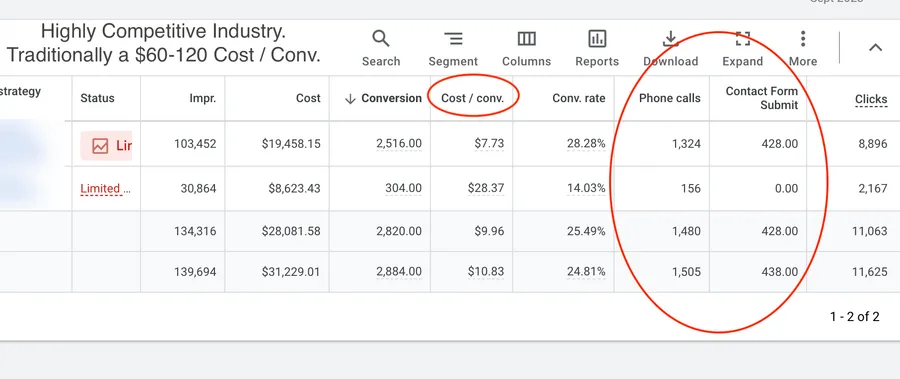
We integrate with Halaxy, Cliniko, Splose, Nookal, Power Diary, and the major CRMs that healthcare actually uses. Where direct integration is not possible, we implement advanced call tracking with AI transcription so every phone enquiry gets logged, transcribed, and classified as booked, not booked, or wrong number. That data feeds back into Google's Smart Bidding and dramatically improves performance over 60 to 90 days. For medical practices where most conversions come via phone, call tracking is not optional. It is the single most impactful infrastructure investment you can make in your healthcare PPC program.
Budget Management and Competitor Bidding in Healthcare
Use our Australian healthcare Google Ads cost benchmarks to explore the published planning data, source dates and calculation methods. The figures are indicative market information, not a quote or a report of an individual clinic’s results.
Healthcare Google Ads budgets need active management because medical keyword markets are not static. CPCs fluctuate with seasonal demand, competitor entry and exit, and Google's own auction dynamics. We monitor daily spend pacing, reallocate budget between campaigns based on conversion performance, and flag when a market shift requires a strategy adjustment rather than just a bid tweak.
Competitor bidding is common in healthcare PPC. Other practices bid on your brand name, and you may want to bid on theirs. We approach brand defence as a standard inclusion in every healthcare Google Ads account because losing your own branded searches to a competitor costs you the cheapest, highest-converting clicks in your account. Offensive competitor bidding is a tactical decision we make case by case, factoring in the legal landscape, the competitive dynamics of your market, and whether the ROI justifies the spend.
Google Ads for Doctors, GPs and Specialists
GP clinics and specialist practices have some of the highest-intent searches on Google. Bulk billing doctor near me, GP open Sunday, after hours doctor, skin cancer check, mens health clinic. These are people who need an appointment this week, usually today. The ad needs to match the intent in one click, the landing page needs to lead with booking, and your phone needs to be answered.
For specialists, the approach changes. A patient searching for an endocrinologist or a neurologist often has a referral letter in hand and is choosing on location and availability. Our campaigns for specialist practices lean heavily on location modifiers, health fund information, and wait time signals. We also run referrer-targeted campaigns separately, because GPs searching for a specialist accepting referrals deserve different messaging to patients. Practices investing in Google Ads alongside organic search can build on these results with SEO for doctors to reduce long-term acquisition costs.
Google Ads for Dentists
Dental Google Ads is one of the most competitive healthcare verticals on the platform, and it is where account structure matters most. A dental clinic that runs one campaign called Dental Services is burning money. We split every dental account by procedure: general dentistry, emergency dental, cosmetic dentistry including veneers and whitening, implants, Invisalign and clear aligners, paediatric, and sleep dentistry where relevant.
Dental services need different enquiry paths. Emergency appointments need clear hours and a staffed phone route. Implant and veneer consultations need detailed assessment and cost information. Our dental Google Ads service separates these campaigns, while dental SEO supports relevant organic searches.
Google Ads for Allied Health, Mental Health, and NDIS
Allied health Google Ads covers physiotherapy, chiropractic, psychology, osteopathy, podiatry, exercise physiology, dietetics, speech pathology, and occupational therapy. For physiotherapists and chiropractors, we build condition-led campaigns around sciatica, lower back pain, neck pain, shoulder injuries, sports injuries, and post-surgical rehab. Google Ads for psychologists and mental health practitioners needs extra care because mental health ads face tighter platform scrutiny, so we stay within service descriptions, Medicare Better Access messaging, and bulk billing availability.
NDIS Google Ads has its own playbook entirely. Participants and support coordinators search differently to private-pay patients, and the conversion path usually involves a service agreement rather than a same-week appointment. We build separate campaigns for participant-direct and support coordinator searches, and maintain aggressive negative keyword lists to keep out job seekers and general NDIS information traffic. Our dedicated Google Ads for NDIS providers page covers the full approach including search term strategy and multi-stakeholder targeting. NDIS providers looking to build long-term organic visibility alongside paid search should also consider NDIS SEO as a complementary channel.
Performance Max for Healthcare Practices
We assess Performance Max against the practice's services, available campaign controls and healthcare restrictions before recommending it. Any test needs a defined budget and reporting plan, without patient-list or health-related website audiences.
Where PMax fails in healthcare is as a primary campaign type. The lack of keyword-level control means you cannot ensure your ads only show for searches that match your Ahpra-compliant messaging. We have audited healthcare PMax campaigns showing on YouTube kids' content, irrelevant Display placements, and search queries that had nothing to do with the practice's services. Our approach is to layer PMax on top of a well-built Search foundation, with proper audience signals and placement exclusions, so it extends your reach without cannibalising the conversions Search was already delivering.
Why Generalist Google Ads Agencies Fail Healthcare Clients
We audit Google Ads accounts managed by generalist agencies every month. The patterns are consistent. They do not understand Ahpra, so their ad copy is either bland or quietly non-compliant. They rely on Performance Max because it is easier to manage. They track form fills because actual booking integration is hard. They write the same landing page template for every vertical. And they have never built a negative keyword list specifically for medical, dental, or allied health traffic.
None of this is stupidity. It is scale. A generalist agency managing accounts across 15 industries cannot afford to develop healthcare-specific PPC expertise for one client. We can, because it is the only thing we do. If you want a healthcare Google Ads agency that genuinely understands your regulatory environment, your patient journey, and your practice economics, book a free audit and we will show you exactly what we would change. Google Ads for healthcare is not a set-and-forget channel. It demands specialist knowledge that compounds over time, and that is what we bring to every account we manage.